Small Delights: Surprise as Strategy
Small moments of surprise can create lasting connection. An exploration of hidden details, play and how delight can become a deliberate design strategy.
Voilà, au-delà de mes petites bouteilles aux chapeaux mignons
Imagine you’re about to launch your range of fruit smoothies in France. The team is in final-prep mode when someone says: “You know what will really make these fly? … Little knitted hats.”
I was in Paris, in what I think was the French equivalent of a NZ Four Square, when I spotted them, rows of smoothies wearing teenie, tiny beanies. Mine was the one with the purple hat (which I still have).
Thanks for reading Bird’s Substack! Subscribe for free to receive new posts and support my work.
Who knitted them?
A gathering of nanas, giggling over tea?
The shoemaker’s elves, moonlighting from leather work?
A renegade craft crew cold and tired of knitting jumpers for fences and trees?
Barbie’s wardrobe department?
I wondered if hatted bottles outsold the rest. Were they more charismatic? Did their cute little bonnets sway hearts and wallets like it had mine? How do you even transport them - elastic straps, tiny hatpins? So many questions (and the answer comes later).
And so begins today’s kōrero: petits éclats de joie—little bursts of joy—with a side of Easter Eggs.
What Are Easter Eggs if Not Chocolate?
In digital culture, Easter Eggs are hidden messages, features, or inside jokes slipped into media, products, or experiences by their creators. They’re not obvious and you have to notice, explore or work to unlock them.
The term was born in 1980, when game designer Warren Robinett hid his name inside the Atari game Adventure. The reference was immortalised in Ready Player One (2018), where the final challenge is about finding that hidden credit not winning the game. The point: the real treasure isn’t the prize, it’s the play.
Easter Eggs can be found in games, films, websites, packaging, anywhere a creator wants to leave a special something for the curious and observant. Here’s a collection found with help from my trusty friend Kōrero. Disclaimer - I have not tested these.
On the Web
Google “do a barrel roll” – The whole page spins a 360° somersault.
Google “askew” – Your results page tilts, just to mess with you.
Google “Google in 1998” – Search like it’s Y2K again.
Google “zerg rush” – Little “O” characters attack your results—click to survive.
Chrome Dino Game – No internet? Tap space bar to help a pixel T-Rex jump cacti.
In Games
Minecraft – Name a rabbit “Toast” for a one-of-a-kind fur pattern.
Halo – “Birthday Party Grunt” mode: headshots explode in confetti and cheers.
The Sims – Your garden gnome has a habit of moving when you’re not looking.
Animal Crossing – Wish on a shooting star and wake up to rare crafting fragments.
In Software & Apps
Excel 97 – A hidden flight simulator, because spreadsheets can be fun too.
Spotify – Some Stranger Things playlists flip the interface upside-down.
Slack – Type /shrug and get ¯\(ツ)/¯.
Trello – Enter the Konami Code and watch cats rain across your screen.
In Pop Culture
Pixar’s A113 – A nod to their CalArts classroom, hidden in nearly every film.
Marvel Movies – Stan Lee popping up everywhere like your friendly cosmic uncle.
Star Wars – The Wilhelm Scream: one dramatic yell, reused in movies for decades.
That’s what I love about symbols, easter eggs and tiny little hats for bottles: they’re little messages for others.
They reinforce that the world is full of wonder and magic.
Art as the Original Easter Egg Hunt
Artists have been leaving us messages for centuries. Leonardo da Vinci and The Last Supper with hidden geometry (and maybe a piece of music). Michelangelo may have painted God’s cloak in The Creation of Adam to mirror the human brain. Salvador Dalí’s melting clocks hide self-portraits and Diego Rivera’s Man at the Crossroads was packed with political symbols so controversial the original was destroyed.
Then there’s Hieronymus Bosch’s Garden of Earthly Delights—a 16th-century fever dream of strange creatures, visual jokes, and hidden stories.
Artists have always known that layering meaning rewards the curious. Today, brands and creators can use the same to make experiences richer and more memorable.
Tiny moments of joy
Our hero images at Mahuki (designed by the brilliant Vanessa Smith), were deliberate with layered meaning in recognition of the rich story telling role of museums and galleries. Here’s two of my favourites:
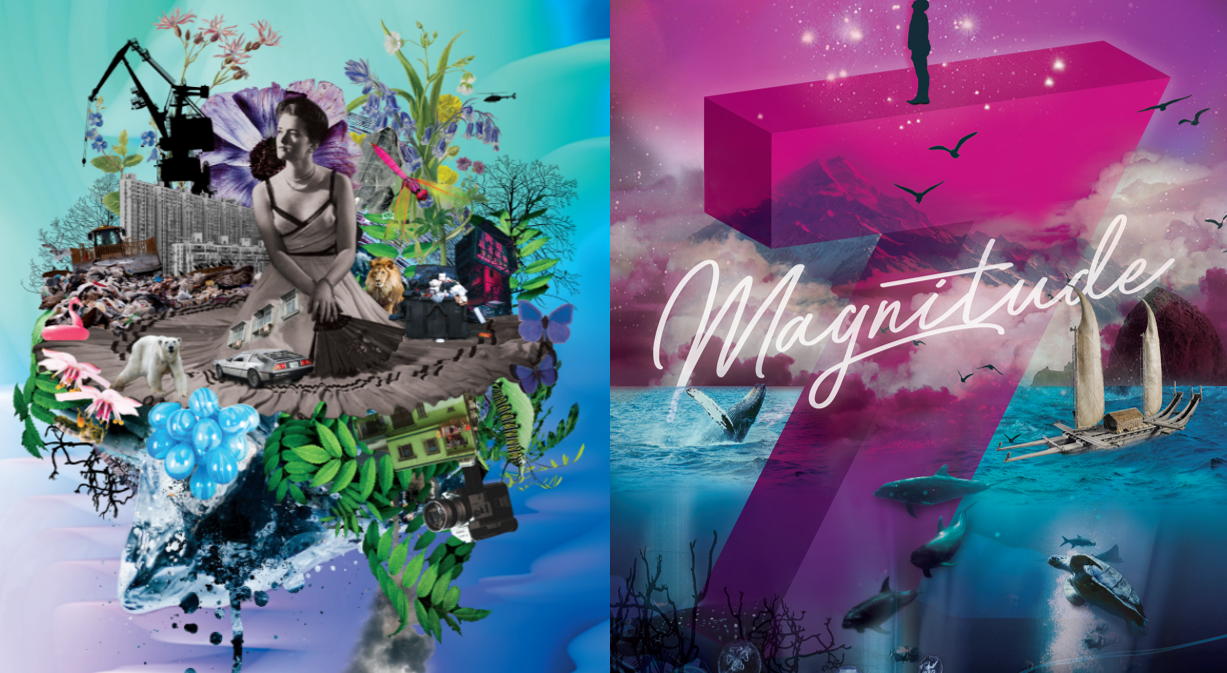
Gaia and Magnitude 7, Vanessa Smith
Gaia – A poster campaign to attract more social-impact / for purpose ventures into the accelerator. In this one Vanessa has included references to climate change, surveillance technology, the Delorean from back to the future (why not and also a reference to being good ancestors) and the Flamingo blow up we had in our space. The main character, the beautiful lady, is a Te Papa image - a nod to drawing inspiration from the collection.
Magnitude 7 – This feels like wonder to me. It was designed for our pre-accelerator programme for Māori and Pasifika teams. References to wayfinding, an epic journey from the depths of the ocean to the highest mountains and out to the stars and matariki of course. The name of this programme came from the brain talent at Ocean Design . Turns out that magnitude is not just the way you measure earthquakes but the luminosity of stars and at magnitude 7 they are no longer visible you have imagine them. A fitting metaphor for start-up entrepreneurs.
We used other cues to create rituals, connection and belonging in the accelerator. Each year we ‘incubated’ a new group of companies and each cohort had its own audio signature, one year, the theme from The Good, the Bad and the Ugly. Another year, Michael Jackson’s Don’t Stop ’Til You Get Enough. When the music played, everyone knew to gather. It was our version of a secret handshake and a great way to start on time.
In a high-pressure environment, these symbols and rituals worked like cultural glue. They were reminders that we belonged, and that play still mattered.
Entrepreneurship is tough and not for the faint hearted.
In hard work, little bursts of joy keep you going. Like the year our community manager Christine kept everyone fed on a shoestring budget with toasted cheese sandwiches. Christine is also an amazing illustrator and her cheese toast t-shirt design is in my top 5 start-up t-shirts of all time.
A Real-World Easter Egg
Hidden meaning isn’t just for galleries and games it works in the wild too.
In 2014, Whittaker’s Chocolate and Starship Hospital brought the Big Egg Hunt to New Zealand. 100 giant eggs were painted by leading artists were hidden in public spaces, then auctioned for charity.
The Big Egg Hunt took something familiar and joyful (chocolate eggs), scaled it up in a way no one expected, hid them in plain sight across the country, and gave people a reason to search, share, and connect. That’s the power of thoughtful surprises in action: they create a story people want to be part of, and a moment they’ll remember long after the egg is gone.
I worked in an office with one of these eggs - won at auction by John and Miriame of Experience networks (later IDIA).
Surprise as Strategy
Surprise can be a strategic design choice. Done well, it can:
Deepen emotional connection – People remember how you made them feel.
Encourage exploration – Get them to look again and notice more.
Spark sharing and buzz – Everyone loves to be “in the know.”
Signal care and craft – Small touches show pride, not just profit.
Build loyalty – Reward attention and people will come back.
But surprise needs intent. It should be anchored to your values, audience and story. Used well, it’s seasoning: enough to lift the dish, not drown it.
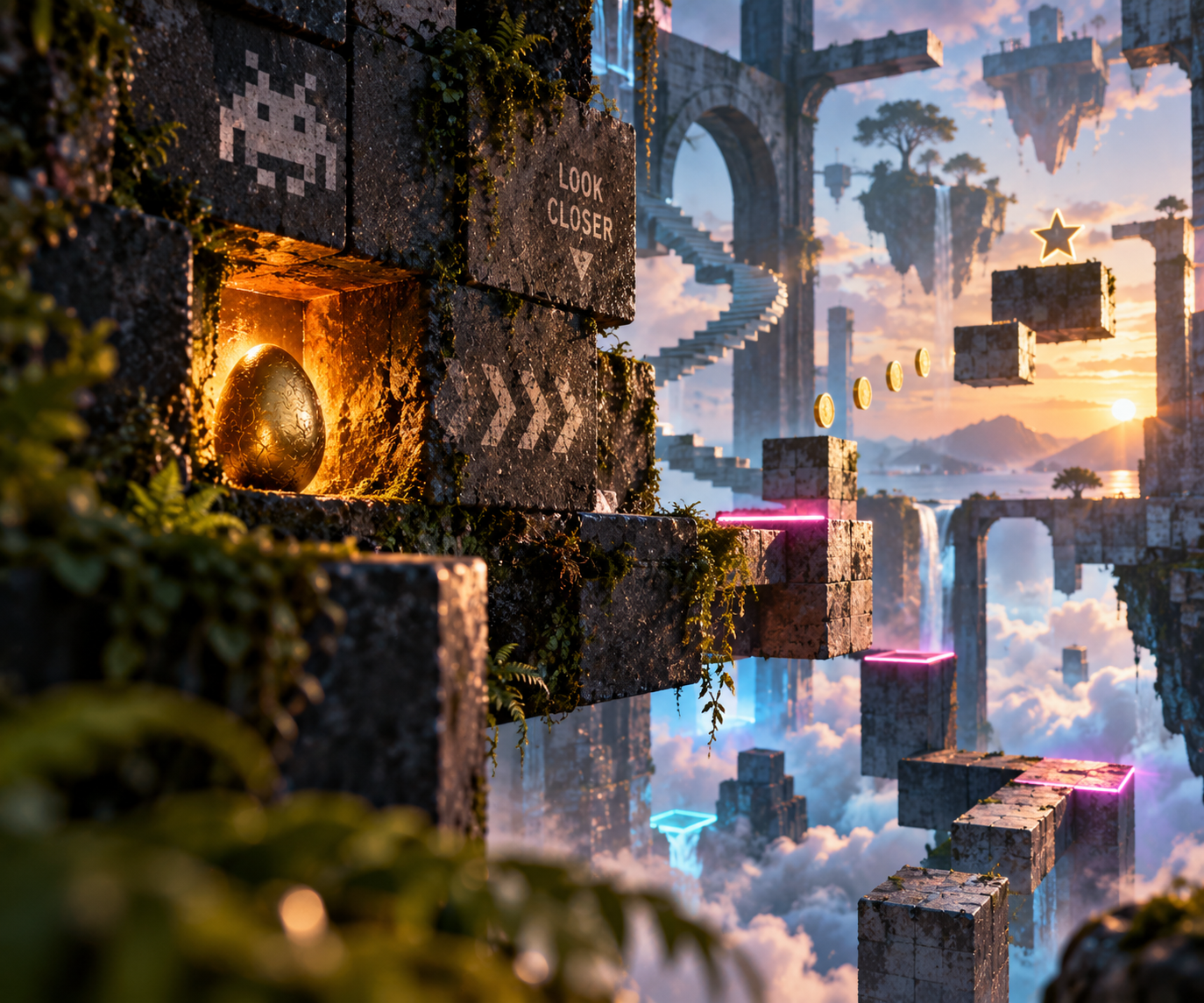
And here is a clue to an easter egg left for you in a major National Institution. I’ve hidden the ‘egg’ - what could it be? Happy hunting.
The Answer to the Hats
The smoothie hats are part of Les petits bonnets, a French initiative to help isolated elderly people. Volunteers knit the hats, which go on bottles in stores between December and March. For each bottle sold, the company donates towards meals organised by the Little Brothers of the Poor.
Sometimes an Easter Egg is just for fun. Sometimes it’s a knitted hat that keeps someone company over lunch.