When Imagination Meets Devotion
What happens when we love imagined worlds enough to build upon them? An exploration of fandom, creativity, belonging and the possibilities created through participation.
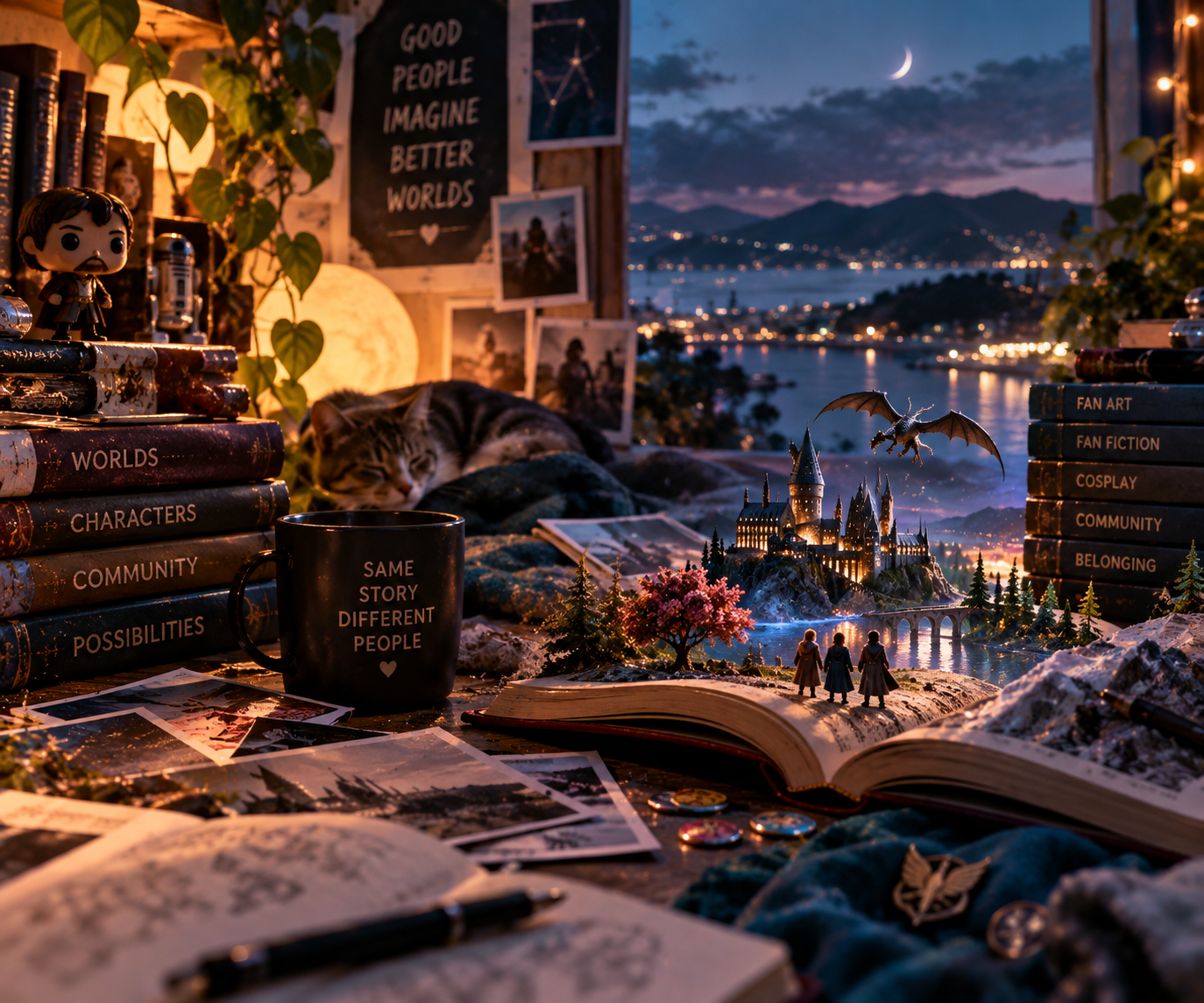
Do you remember where you saw Star Wars - the first movie? I saw it in Gisborne at the Regent Theatre on Gladstone Road. This was the late 70’s, so I appreciate younger readers may have seen it online. For us Gen X’ers, the disco dancing, flare-wearing, Rubik’s Cube-solving, space invader playing kids, Star Wars blew our mixed tape loving minds.
When Star Wars premiered in 1977, it created an entire new world. The special effects, groundbreaking for their time, were applied with vision and artful restraint and always in service of world-building the Star Wars Universe. The franchises lasting power is in my view, equal parts awesome story, a hot young Harrison Ford and the imagination, craft, and love poured into every frame.
Thanks for reading Bird’s Substack! Subscribe for free to receive new posts and support my work.
World-building convinces us that what we’re seeing (or reading) is a living, breathing universe with its own rules, history, and culture. Star Wars set a benchmark here. That’s why it endures because people still want to return not just to the plot, but to the galaxy itself.
In my last blog I wrote about fluency of ideas and even sketched out some possible jobs of the future with one of them a “planetary settlement designer.” But of course, entire genres of brilliant minds have already been building worlds for us through imagination and creativity. J.K. Rowling’s Harry Potter is one beloved example, but writers have been crafting universes for centuries, populating them with rules, histories, and cultures that feel real.
World-building sits at the intersection of creativity and possibility. It asks us to imagine a place so rich that we believe in it and sometimes to believe so strongly that we set about creating it. From Tolkien’s Middle-earth to the galaxies of Star Wars, these worlds expand the boundaries of what we think is possible. And as we look to the futures ahead on this planet and maybe others, world-building might be all of our work. A critical skill for leaders, entrepreneurs, scientists, and communities - the ability to imagine a different (better) world and then inspire people to make it real.
But I’ve actually gone off on a tangent into world building when what I wanted to write about was loving the worlds imagined for us so much we become super fans. Which sets off a whole new train of creativity and innovation.
Star Wars Uncut
Let’s fast forward three decades to 2009, when filmmaker Casey Pugh launched Star Wars Uncut, slicing A New Hope into 473 fifteen-second clips and inviting fans around the world to recreate them however they liked. I watched many of those clips - storm-troopers represented by beer bottles, kids playacting stormtroopers with pool noodle light sabres in their backyard and lego figurines, alongside some wicked animated clips. Some had realistic costumes others used salad bowls as space helmets. Each scene was stitched together and released as a full feature in 2010. Resulting in a fan-made film that went on to win an Emmy. It was followed by Empire Uncut in 2014, proof that when people are given the chance to play, remix, and contribute, their collective imagination can reassemble even the most iconic of stories into something entirely new.
Fan Love Innovation - The wonder and creativity that is sparked by love and admiration of the creativity of others.
Did you know that when you visit a Disney Theme Park, you aren’t allowed to dress in costume if you are over 14? This is to avoid confusion with official characters. Out of that restriction, fans created a whole subculture known as Disneybounding, where everyday outfits are styled to reference beloved characters through clever colour choices and accessories. A red T-shirt with yellow shorts is Winnie the Pooh, a purple dress with green accents nods to Ariel, and black, red, and yellow pieces hint at Mickey. Similar expressions of coded dress show up elsewhere too: at Universal parks, Harry Potter fans wear house-colour scarves and themed accessories rather than full robes; in sports, fans remix jerseys or team colours into streetwear; and at concerts, whole crowds dress to honour the artist from cowboy hats and boots for Beyoncé’s Renaissance tour to glitter and friendship bracelets at Taylor Swift’s Eras Tour.
Technology now amplifies these signals even further. Apparently, K-pop fandoms organise light-stick “oceans,” where tens of thousands of glowing devices form a shared choreography in the stands. Augmented reality filters let fans step into a performer’s world, layering digital spectacle over physical presence.
Whether it’s subtle colour codes, handmade accessories, or immersive tech, the through-line is the same: fans don’t just consume culture they co-create it, finding ways to make belonging visible, vibrant, and unforgettable.
Cosplay, short for “costume play”, is one of the most vivid ways fans show appreciation, by literally stepping into the skin of the characters they love. What began in the 1970s with science fiction conventions has grown into a global art form, with dedicated communities, competitions, and entire economies of makers, fabricators, and photographers. Some costumes are painstakingly screen-accurate; others are playful mash-ups or reimaginings that bring characters into new contexts.
Technology has taken it further: 3D printers churn out armour and props once impossible to replicate; LEDs and microcontrollers light up costumes with theatrical flair; social platforms let cosplayers share tutorials, build followings, and inspire others to join in. At major conventions like Comic-Con, you see whole halls transformed into living worlds where a casual wander down an aisle means bumping into superheroes, anime protagonists, Jedi, or original characters dreamed up by fans themselves. It’s a reminder that fandom isn’t passive: it’s participatory, inventive, and constantly evolving through the imagination and dedication of its communities.
I remember taking my son to the Wellington Armageddon where I bought a DVD of Sharknado and almost bought Soldier Zombies at the Disco (or something like that). The following year I went back to the same stand and asked if they still had Soldier Zombies at the Disco. Without skipping a beat the stallholder replied that they weren’t stocking that particular sub-genre at this time. I loved his inclusive, non-judgemental response and that the world is indeed full of nuanced sub-genre’s and that people around the world (enabled by technology) are able to connect on their particular interests – no matter how obscure. Which brings me to … My Little Ponies.
From Toy Aisle to Global Fandom: The World of My Little Pony
It began in the 1980s as a colourful toy line and has blossomed into one of the most surprising and creative fandoms in the world. My Little Pony found a whole new life with the 2010 reboot Friendship Is Magic, which didn’t just appeal to children but drew in teenagers, adults, and whole communities who connected with its characters, values, and sense of joy. The fans known affectionately as “bronies” and “pegasisters” built a culture that stretches far beyond the toy aisle into conventions, fan fiction, art, music, podcasts, and even scholarly research have explored the phenomenon.
At its heart, the fandom is about creativity and belonging. Fans create their own “ponysonas” (original pony characters that represent themselves), design new storylines, compose songs, and produce elaborate animations much of it shared freely online. Technology has fuelled this growth, making it easy for fans across the world to collaborate, remix, and showcase their work. Conventions like BronyCon in the U.S. once attracted tens of thousands, while countless smaller gatherings still celebrate the shared wonder of pastel ponies.
What makes this fandom remarkable is its resilience and generosity. My Little Pony became a canvas for people to express themselves, to explore identity and friendship, and to demonstrate how a franchise designed for children could become a platform for some of the most creative and unexpected fan contributions anywhere.
Closing thoughts
I no longer own a DVD player and my tastes have changed so I don’t fancy sitting through “Soldier Zombies at the Disco,” so much anymore. But I could be up for a ponysona. I do already have a dance persona, but that’s another story.
What all these stories really point to is the value of following your curiosity and interests. Whether it’s remixing Star Wars, colour-blocking as Winnie the Pooh, or creating a whole new ponysona, fandom is a reminder that pursuing what you love is never wasted. It builds skills, sparks imagination, and connects you with others who share your wonder. Personal development doesn’t always come from formal training or a tidy plan sometimes it grows out of the things that delight us, the obsessions we can’t put down, and the worlds we’re brave enough to build or join.
Postscript
Top five lines from the Star Wars Franchise:
“May the Force be with you.” – the quintessential Star Wars phrase
“No. I am your father.” – Darth Vader’s revelation to Luke in The Empire Strikes Back. The twist few of us saw coming.
“Do. Or do not. There is no try.” – Yoda’s iconic teaching, shorthand for commitment and perseverance.
“Help me, Obi-Wan Kenobi. You’re my only hope.” – Princess Leia’s hologram message that sets the Star Wars adventure in motion.
“I’ve got a bad feeling about this.” – a recurring Easter egg line, appearing in nearly every movie.