Designing the Queue
Waiting is part of the experience. An exploration of how anticipation, attention and seemingly small design choices can shape our memory of an entire journey.
Just how interesting could a newsletter about waiting in queues be? Let’s find out shall we.
I’m writing this at Auckland Airport, fresh from the security line. I arrived at the tail end of several flights, so the pathway was on full horizontal layout. I walked that zig-zag about five times with no one actually ahead of me, feeling the person behind me inch closer, urging me to go faster. New arrivals eyed the black tape, weighing up whether they could skip half the maze. For reasons I cannot defend, I felt morally responsible for ensuring they did not do that.
By the time I reached the front and was placed in the slowest lane, I was both zoned out and strangely on edge. Official settings do odd things to me. I experience irrational guilt, imagining that giant scissors have just manifest in my hand luggage. I worry about missing my flight even when I am two hours early. And then there is the awkward ballet of dodging people, trays and stray boots on the other side. Ten minutes in total. A disproportionately anxiety inducing experience.
And yet I have waited joyfully for over an hour at a theme park. Or gratefully at a government counter when something important simply must happen today or online for hard-to-get concert tickets. Queue design for waiting is emotional design.
The Psychology of Queues
Every queue is a tiny social experiment in fairness, patience and perceived control. And, as the research shows, it’s not the duration of the wait that frustrates us. It’s how the wait feels.
The Queue-it article “The Psychology of Queuing: Revealed in 6 Simple Rules” captures this well. Perceived time matters more than the actual minutes on the clock. Unoccupied time drags. People relax when they know the wait has begun and progress is being made. Uncertainty and unfairness heighten irritation. Honest timing, visible movement and small psychological buffers calm the nervous system.
When waiting feels predictable, fair and purposeful, we tolerate far more than we realise. But we also have an opportunity to make waiting an amazing experience.
Disney: The Masters of Emotional Architecture
At Disney parks, queues are part of the performance. Imagineers design every millimetre to shape mood, movement and meaning. You are never “just waiting.” You are already in the story.
Average wait times for popular Disneyland rides sit consistently between 30 and 45 minutes (Queue-Times; TouringPlans). The park has about forty-nine rides, so if we are there for a typical day (8 hours) and we take out lunch and meandering time and you’re left with roughly six hours of ride time. That translates to ten to fifteen rides on a normal day, twelve if the stars align.
And people pay US $104–$224 for a one-day adult ticket and queue happily for hours. I have.
If you’ve been there, you’ll remember the surreal pre-opening ritual: buses unloading, crowds building, everyone gathered in the little Disney town inside the gates waiting for the clock to strike nine. When the gates opened, people started rushing to their first ride. I was swept into the rush towards Space Mountain, surrounded by neon light and the rising certainty that I had no idea what I had signed up for. The not-knowing was half the thrill. I did the same thing for the Twilight Zone Tower of Terror. Part of the design of these things is that they don’t reveal everything all at once. We started nice and slow with some manageable jump scares and nek minute I’m hanging outside of a three story building. It was terrifying. So much so I needed to do it again.
Disney isn’t just a theme park. It’s a masterclass in behavioural design.
Case Study: Seven Dwarfs Mine Train — The Gamified Queue
One of Disney’s most elegant examples is the queue for Seven Dwarfs Mine Train, where waiting becomes part of the play.
You sort shimmering gems rushing through a sluice channel, play musical notes on carved woodland-animal taps, spin glowing gem barrels that project dwarf silhouettes onto the ceiling and if seven strangers waiting in the queue sync their spins, Snow White herself appears in a secret animation. No one tells you this and it is a delightful moment that also creates a knowing bond with your fellow waiters. In this case the queue becomes a moment of collective triumph and curiosity is rewarded,
This is curation at its finest. And I love that it is about the moments in-between, the bit before the main event. Which if you have been following my work is what I love most – the inspiration on the edges.
Designing for Safety When It Really Matters
But Disney’s choreography is not just about magic. With 47,000 visitors a day, they must design for safety, wayfinding and crowd control at a scale most cities struggle with. Their queues are where imagination and logistics meet.
When public health and safety are at stake, the stakes of design rise sharply. Queue psychology stops being a matter of comfort and becomes a matter of protection. In emergencies, vaccination centres, and evacuation zones, the flow of people must be calm, clear and humane because confusion can tip quickly into harm.
And in sensitive settings, design matters even more. My son recently spent seventeen hours waiting at Accident and Emergency and was asleep on the waiting room floor when I arrived. The first triage happens publicly in a room full of strangers — hardly ideal when discussing private health matters. “There is something going on down there”, said no one out loud in a hospital ever. He had food poisoning by the way. None of this is the staff’s fault. It is simply what happens when demand outstrips design.
Good design reduces panic, directs attention, protects privacy, and ensures those who need help most get it first. These environments demand the same emotional intelligence as a theme park, but with far higher consequence. When the system is under pressure, design becomes not just a nicety but a lifesaving discipline.
Here are some other examples of designed waiting.
Retail Rituals: Exit Through the Gift Shop
Retail uses many of the same psychological levers. The classic “exit through the gift shop”. After a ride, you are buzzing. You want a keepsake (an artefact of the journey). Retail design simply places the keepsake (could be a photo) in your path.
Mecca and Sephora do this with finesse. At the counter you’re greeted by gleaming miniature serums, glosses and perfumes arranged like little jewels. These micro-treats hit at exactly the right emotional moment. I know this only too well. Even supermarkets know this: confectionery, magazines and last-minute temptations positioned exactly where time slows.
Behind the sparkle lies rigorous design, sight lines for security, space for prams and bags, lighting calibrated for appeal, flow engineered for movement. Beauty with backbone.
Museums and Scarcity: The Mona Lisa Effect
Museums operate on a different emotional frequency. Those with high value, in-demand artefacts don’t entice with abundance. They elevate the rare. The slow, ritualised approach to the Mona Lisa is the purest example.
Seeing the painting is not a simple visual encounter. It is a deliberate arrival. You move through a grand gallery, guided forward by architecture, pacing and the collective hum of anticipation. The crowd compresses. The sightlines narrow. Every environmental cue tells you that you are approaching something of significance.
In this context, the queue becomes part of the meaning. Waiting performs the value of the object. By the time you stand before the painting, the few seconds you receive feel earned, almost sacred. Scarcity heightens significance and reverence does the heavy lifting.
Regrettably I haven’t seen the Mona Lisa in real life – but I have been told she is surprisingly smaller than many expected given her incredible pulling power.
Perpetual Twilight: The Las Vegas Illusion
Las Vegas takes emotional design in another direction altogether. Many casinos and shopping complexes operate under a perpetual twilight, an artificial sky painted in soft blue-pinks, lit to hold you in a state where anything feels possible.
Twilight keeps people alert yet relaxed. It smooths fatigue and dissolves time. With no clocks, windows or natural cues, hours blur. You wander, shop and play unaware of how long you’ve been inside.
Case Study: JIX Reality — The Virtual Receptionist
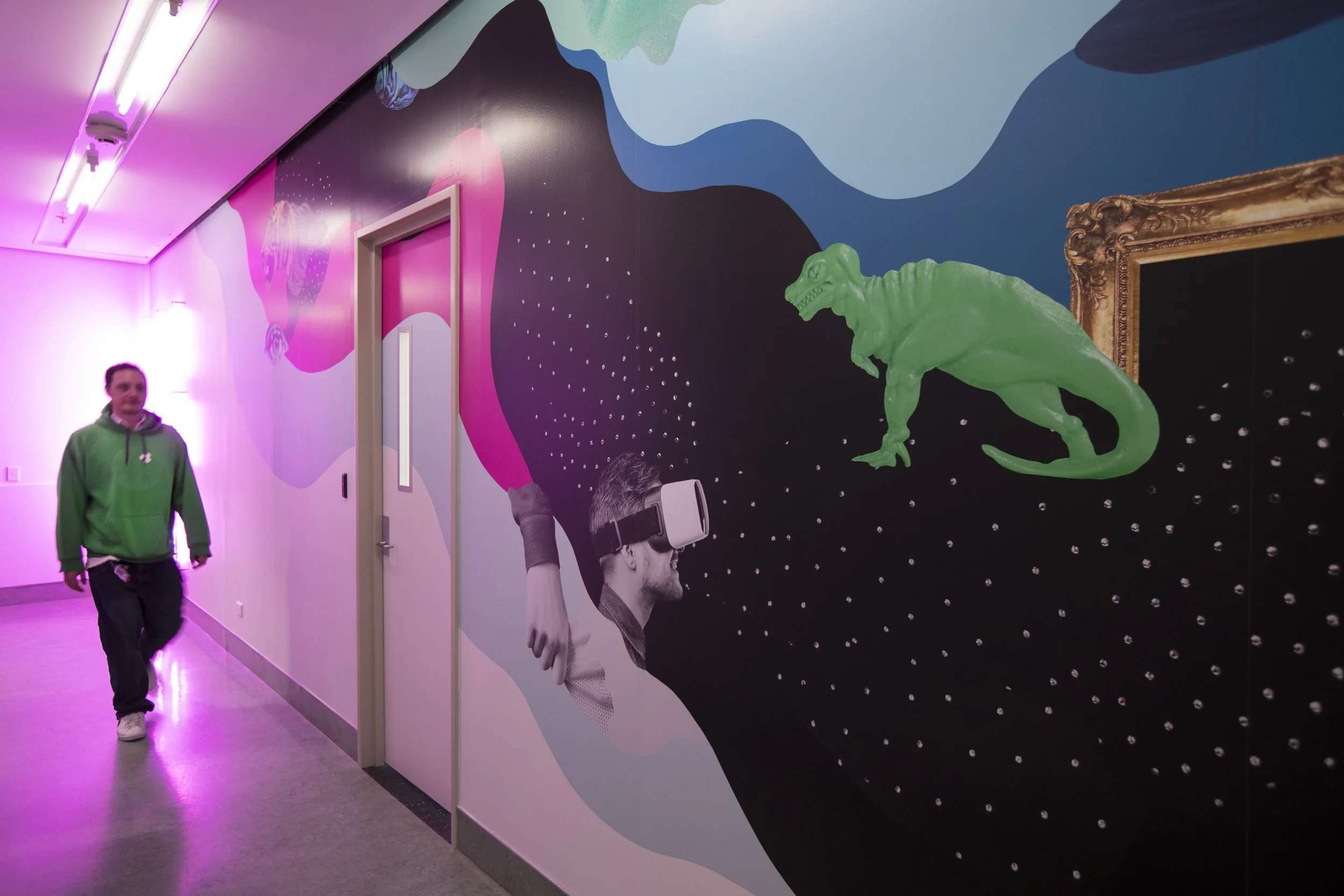
Closer to home, Ōtautahi’s JIX Reality has completely reimagined the waiting moment through a virtual receptionist that greets and orients visitors as soon as they arrive. It looks like clever tech, but the real power sits in the cultural design behind it.
This work began in partnership with iwi, shaped through extensive engagement to ensure it was culturally grounded and effective. JIX worked alongside kaumātua and iwi leaders to design a bilingual, culturally sensitive virtual wahine who could welcome people in both English and te reo Māori. Her gestures, tone and interaction style were co-designed to reflect manaakitanga rather than mimic a generic avatar.
The first implementation, inside an iwi innovation hub, showed how transformative this can be. JIX’s approach shows how a simple queue moment can be redesigned through culture, technology and empathy turning a pressure point into an invitation.
Lessons From Queue Psychology: Transforming Stress Points
Every organisation has pressure points, the moments where people tense up, lose patience or feel unseen. Queue design and psychology gives us a lens to redesign those moments.
Most businesses rely on four familiar waiting systems: the linear queue, the serpentine queue, the take-a-number system and the on-hold phone line. They work, but only functionally. None of them transform the emotional experience.
The first step is noticing where the stress sits. Where do people hesitate? Where do they feel powerless? Where does time thicken? If the bottleneck can’t be removed, redesign the emotional conditions around it.
Online waiting is one of the worst offenders. You sit suspended, listening to music you didn’t choose, unable to step away. A simple call-back helps, but it assumes that I trust you. How could the experience be transformed with technology, AI or gamified? What if we employed retirees who natter with you while you wait? What else could you help me do then that would make the time feel more productive or relaxed? A guided meditation? I’m riffing but you get the idea.
Comfort matters as much as clarity. Anyone who has watched an older person stand for twenty minutes in a bank queue knows this. Chairs, quiet zones, clear processes that engender dignity.
People don’t resent waiting when the waiting is well designed. When they feel safe, informed, progressing and respected. Waiting itself is not the enemy. Poor design is.
Treat your pressure points as creative invitations and you will transform some of the most stressful moments in your customer journey into trust-building ones.