Artefacts and Anchors
Why do some objects become meaningful? An exploration of artefacts as emotional anchors connecting experience, identity, memory and place.
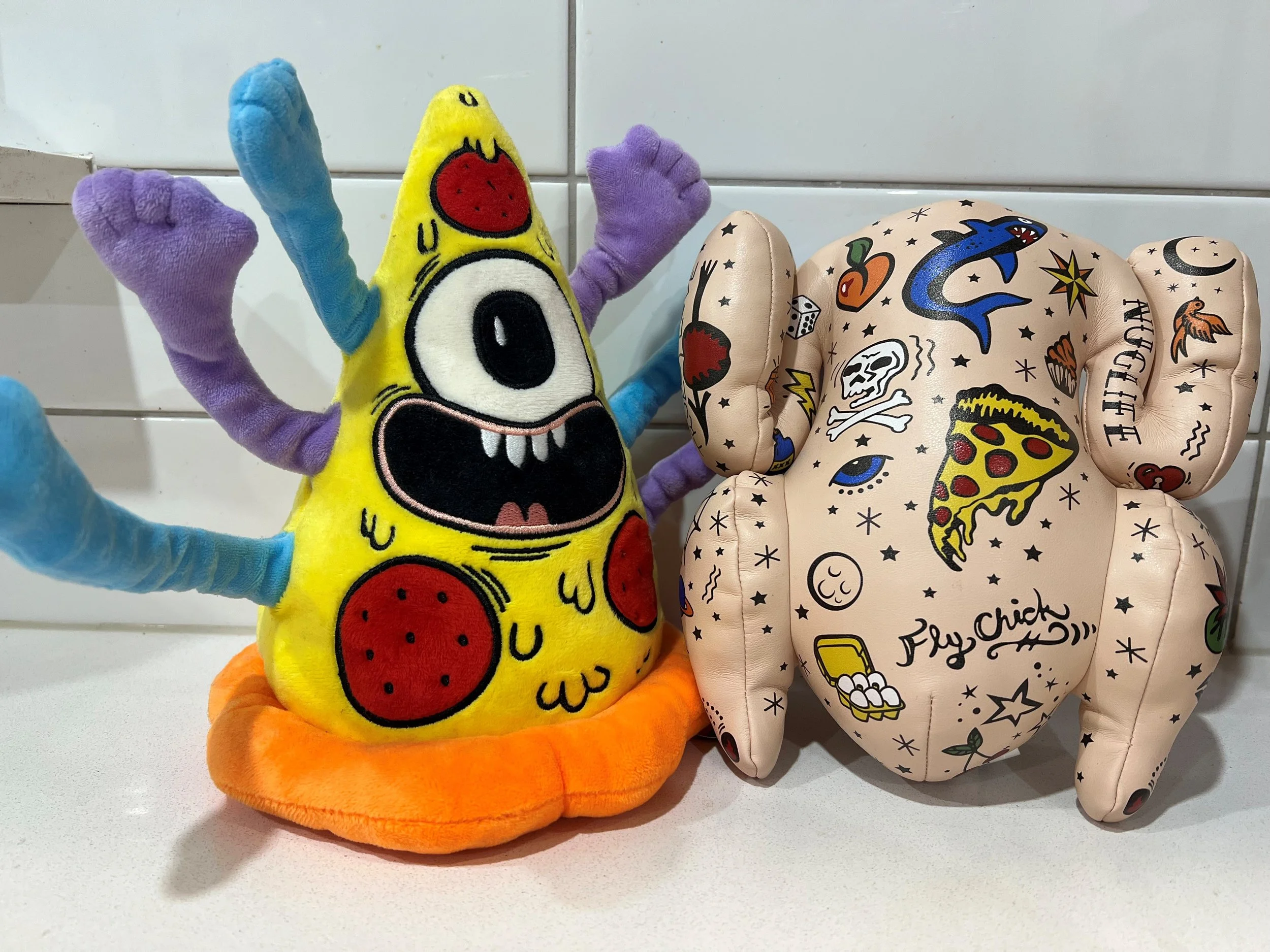
This issue, we’re talking artefacts and anchors. Those tangible expressions of story and emotion and what they teach us about memory, meaning, and the future of strategy
Take, for example, my tattooed rotisserie chicken. I didn’t know I needed one until I did. He now sits on my dresser beside his best mate: a plush cyclops pizza slice with bendy arms. Both came from the Meow Wolf gift shop, acquired in a post-experience haze of joy, delight and a low-key smugness that the risk of others back in Aotearoa having both of these little beauties was low.
This is emotional anchoring: when objects (or smells, or sounds, or textures) act as bookmarks in the story of our lives. These items are memory vessels capturing not just what we did, but how we felt. In my case elated, playful and weirdly seen. Who wouldn’t want to remember that?
Gift shops in cultural institutions aren’t just about revenue. They’re an extension of the experience giving visitors a way to carry something home and to hold the moment in their hands. When done right, these keep-sakes help make sense of what we’ve just seen and felt. Long after the fact they also remind us of who we were at that moment in time.
I once horrified my colleagues at a major museum by suggesting we hire out some of our ‘lesser’ objects as props for film studios. We were brainstorming revenue generating ideas. In museum-world, there are no lesser objects. Everything is consciously curated, catalogued and held with care. Every item has a whakapapa, a backstory.
To the untrained eye (mine), some museum pieces didn’t look like much.
But then a curator would speak. They’d unfold the object's story, where it came from, who used it, what it meant, what the world looked like when it was last held. I’d find myself completely entranced.
That’s the power of storytelling and how objects are houses of hopes and dreams. But that’s not all that’s going on….
The Joy of Shopping – the Dopamine of Discovery
I once heard someone describe shopping as modern-day hunting and gathering. Shopping lights up our brains in a very primal way. It’s not the purchase itself, it's the anticipation. That delicious little rush we feel just before we tap the card. It's not just about the object, it’s about possibility and imagining ourselves differently.
While shopping gets gendered as a feminine pastime, the dopamine loop is universal. Studies show men and women respond similarly, they might just call it different things (a splurge versus a collection).
A little dopamine hit helps us craft identity and nowhere is that clearer than in the world of sneakers, luxury, and status-soaked objects…..
Luxury, Sneakers & the Artefact Economy
What I have always wanted most in the world is really cool sneakers. These were unaffordable when I was younger and I was a sporty kid in need of good sports shoes. As an adult, sneakers are my splurge. They are functional, beautiful and a reminder that I’m not that poor kid anymore.
I don’t get the fascination with luxury handbags. But I recognise the drive. The interesting thing with luxury is that it isn’t just indulgence, it is also strategy. Heritage fashion houses engineer scarcity and myth to create emotional gravity. Luxury bags don’t just hold stuff, they hold status, identity and (on the resale market) sometimes a solid ROI.
Even sneakers have joined the artefact elite. High-end or limited-run kicks are now cultural currency. Platforms like GOAT and StockX have turned rare Jordans into wearable investment portfolios.
We could call this the artefact economy—a system where value isn’t just in utility, but in story, memory and identity.
But artefact economics isn’t just the realm of luxury. It’s playing out everywhere from thrift stores to TikTok, and even the merch lanes at Disneyland.
The double, double economy
Just this week, a woman popped up in my feed whose entire (highly successful) content stream is about shopping at Disneyland. Apparently, she goes several times a week just to film the latest merch drops. Another creator documents every fantastical bite they eat at global theme parks such as butter beer and flavoured jelly beans at Harry Potter World. It's retail theatre.
I’ve been known to spiral into thrifting reels watching strangers rummage through second-hand shops. I watched one couple for 40 minutes as they attended an estate sale somewhere in mid-America. …. I don’t know what it says about me either.
While luxury grabs headlines, the real revolution might be happening in op shops and second hand threads. The thrift economy is thriving, not just for sustainability, but for story and experience. TikTok creators are turning $8 finds into fashion moments. It’s remix culture meets value-led consumption.
I’ve been thinking this is the double double economy:
The first sale.
The resale.
The content created around it.
And then? Sometimes the item gets sold again.
That’s four value layers from one object. Wild.
At one point, I wondered if the Disneyland woman was a plant. Then I wondered if I cared. But it did make me pause. Because for all the joy and theatre of this retail renaissance, there’s also a shadow lurking…
The Dark Side: Predatory Design, Emotional Debt and Climate Cost
Not all purchases are innocent and not all persuasion is playful. In the age of AI, retail has become emotionally intelligent but could also be emotionally exploitative.
Algorithms don’t just know what you want, they know when you’re vulnerable. They learn your moods, your spending patterns, and your pressure points.
I was chatting with someone recently about fintech tools that register your purchases. Let’s say your teenager bought a pair of Air Jordans, and then they receive other recommendations for other Jordans they can buy. We know this happens now. But all of this can be linked to buy later schemes which one can assume is only going to get more sophisticated and easier to act upon in an AI driven world. I mean I just linked Flower Mountain shoes in this newsletter. Don’t go crazy people!
Beyond our wallets, there’s the planet.
The Planet Pays Too
Let’s not forget the environmental cost. Every item purchased carries a hidden tag of water use, emissions, shipping, packaging, waste. Fast fashion alone is responsible for up to 10% of global carbon emissions and mountains of landfill. The dopamine hit might be momentary, but the impact can linger for centuries.
Even resale and thrift (though far more sustainable) still feed a cycle of overproduction and overconsumption especially when they’re another excuse to buy more, faster, cheaper.
Future Retail: Strategy as Stagecraft
Retail is not just transactional, it’s cinematic.
We’re already swimming in personalised ads (mine seem determined to turn me into a well-moisturised, collagen-boosted superwoman). But what’s really fascinating is the shift toward experience orchestration where brands use space, spectacle, and sensory immersion to create emotional anchors.
I love shopping malls. I’ll say it loud and proud. I love the anticipated dopamine hit, the bright lights, the variety of food, people watching and the overall experience. I love contemplating the thought that has gone into designing a safe environment and good experience for families, for children - for single women travellers who don’t feel comfortable hanging out at the hotel bar.
In Dubai, the Souk Al Bahar fuses ancient Arabian marketplace aesthetics with ultra-luxe retail. Across town, the Dubai Mall boasts a full-sized ice rink, a virtual reality park, and the Dubai Aquarium with sharks swimming past Chanel. These aren’t malls. They’re multi-sensory ecosystems designed to keep people engaged, enchanted, and inside.
I once found myself contently browsing Cesars Palace mall in Las Vegas. Then realised it was 1am. That opens up a whole thing about engagement design, which we’ll save for another day.
Even airports are getting in on the act. Jewel Changi in Singapore is more than an airport terminal, it is a biophilic wonderland complete with a 40m waterfall.
Experience is no longer the afterthought. It is the product.
What This Means for Strategy and Innovation
Every brand, space, or service has the potential to become a world. Physical environments are more than backdrops and every touchpoint is a chance to anchor a memory, spark identity, or create joyful friction.
The question isn’t just “what are we offering?”
It’s: “What are people feeling while they’re with us—and what will they carry when they leave?”
In today’s economy, storytelling is infrastructure. It’s how we build trust, signal value, and sell things (ethically) in ways that evoke wonder.
Brand love isn’t just earned. It’s designed.
The best artefacts don’t just sit on a shelf.
They sit in your heart.
They remind you of who you are—or who you were becoming.
Final Thought
Whether you’re curating an exhibition, launching a product, or building a business—remember:
People don’t just want things.
They want anchors (and connections)
Make that the centre of your strategy.