Transactional Friction
Beautiful ideas still have to work. An exploration of the hidden costs, maintenance and operational realities involved in turning imagination into practice.
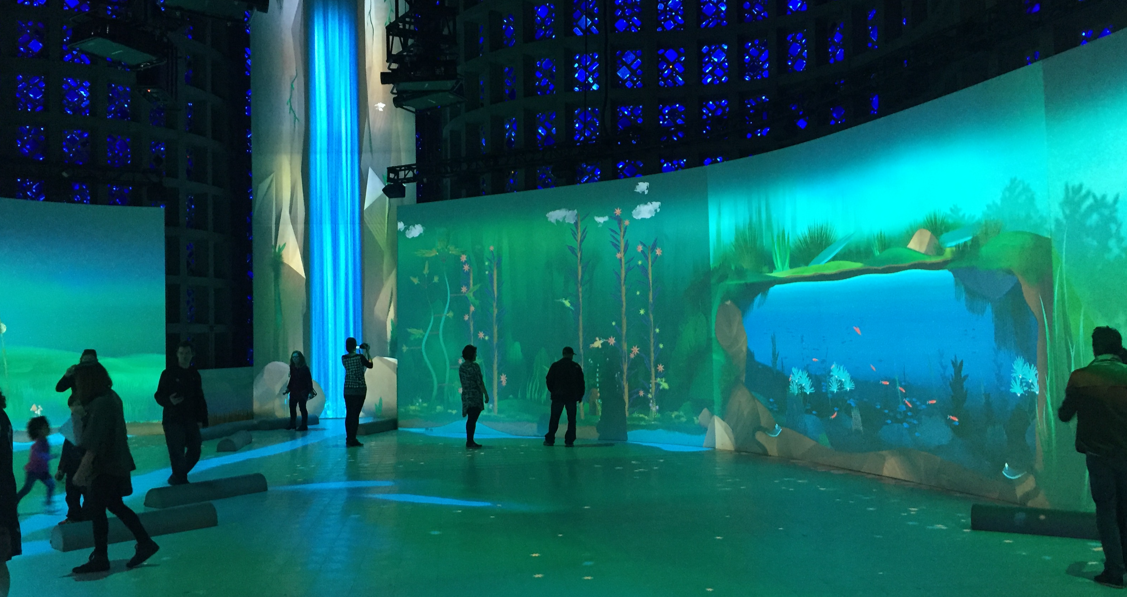
I had the chance to visit Connected Worlds exhibition at the New York Hall of Science (NYSCI) in 2016. The centrepiece was a giant digital waterfall feeding a series of ecosystems arranged around the room.
By accident, we discovered that waving our arms near a world caused plants to grow. The more you waved, the more flora appeared. Then, as life reached a threshold, birds and animals emerged.
We then realised you could move “logs” (the silver shapes on the floor) to redirect water to specific worlds, helping them flourish. But if you sent too much to one world, the others would dry up.
For a short time, Emily Loughnan (the brilliant co-founder of Curio Publisher) and I had the space to ourselves, and every world was in harmony. Then a busload of high school students arrived and within minutes all worlds were back to ground zero. But so began their learning experience.
Later, the staff told us it cost around $50,000 USD a year just to replace the lightbulbs.
That’s transactional friction the hidden effort (and cost) required to sustain something complex. It’s why many beautiful ideas never get off the ground: the friction overwhelms the value.
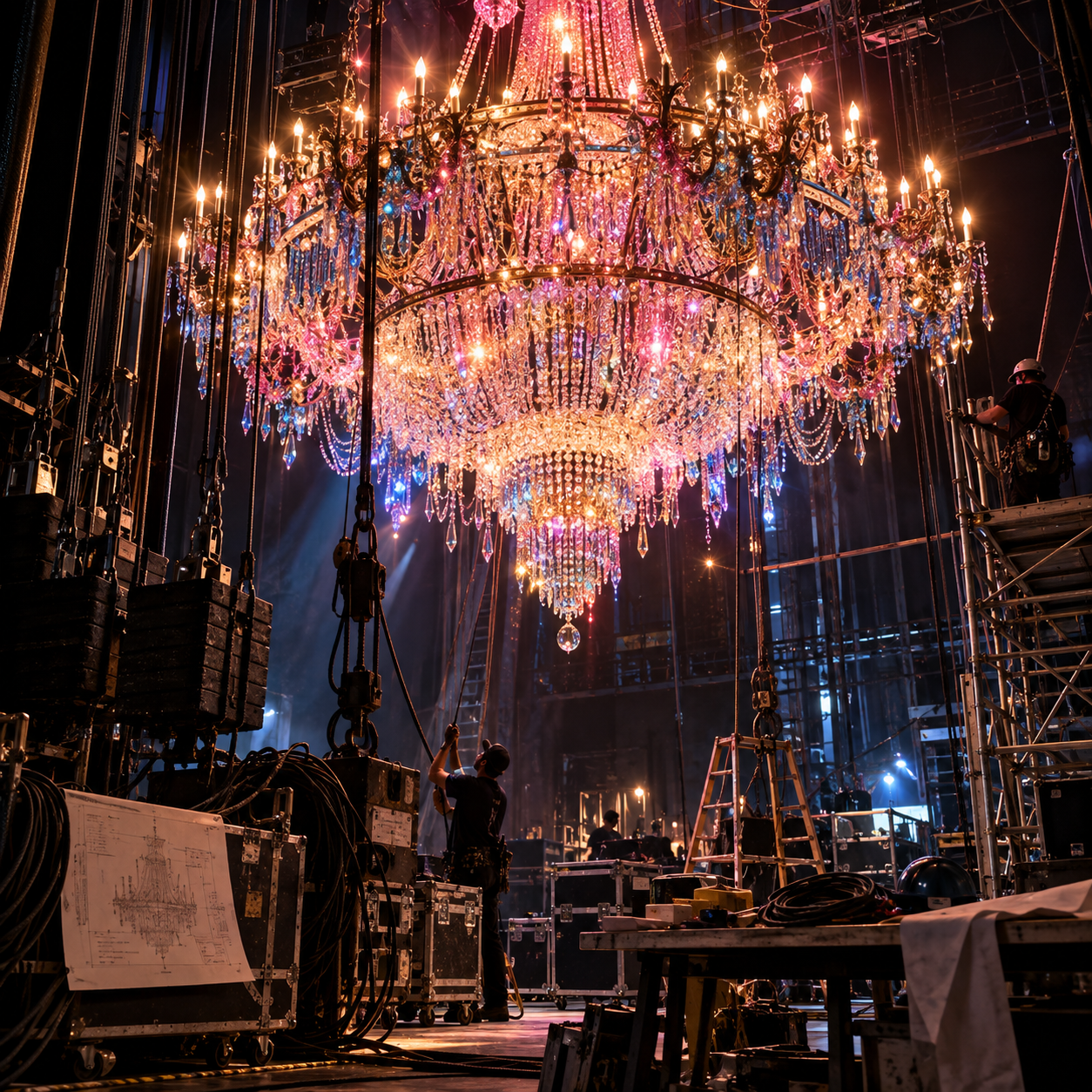
When Steven Spielberg was preparing for the movie - Minority Report, he brought together a team of futurists and technologists to imagine what the world might look like in 2054, the year the film was set. You can read more about that here, but what’s remarkable is how many of those imagined technologies now exist: gesture-based interfaces, predictive policing, personalised advertising, ambient surveillance.
Was it foresight? Or did imagining it make it inevitable?
In a real-world example, I’ve been reading Apple in China by Patrick McGee (2025), which could be read as a masterclass in transactional friction at scale. From the outset, Steve Jobs demanded designs that were often impossible to manufacture. Early prototypes were sleek and pushed engineers to the brink. The only way to realise these ambitions was to reshape entire design - production systems.
That led to a cascade of complex decisions: outsourcing manufacturing from Japan, then to Taiwan, and eventually to China (for cost and capacity). Those regions invested heavily in skills, infrastructure, and sunk costs to meet Apple’s super high standards. The friction was constant (logistical, cultural, operational) but so was the will to overcome it. And it transformed and saved the company.
Imagining something as amazing as Connected Worlds or the i-Mac, or Minority Report is one thing. Building and sustaining it (and changing out the lightbulbs) is a whole other thing.
That’s where transactional friction shows up.
It seems logical that as museums are at the cutting edge of art, science and experience they would also be leaders in technology-based experiences such as Virtual Reality (VR). But VR comes with friction: hygiene protocols, charging, tech support, onboarding and debriefing. It’s generally out of reach for a cash-strapped, resource constrained institution.
Wonder has a budget. You can envision something extraordinary but unless you can reduce the friction, it may never fly.
Which brings me to wonder itself…
The Many Faces of Wonder
Not all wonder needs full noise.
I love hi-tech, fully immersive experiences such as the delightful work by TeamLab from Japan. I visited two TeamLab experiences in Singapore and it is amazing that people in the world are 1) creative geniuses and 2) get to do that as a job.

Gallipoli Exhibition, Te Papa
But some of the most profound moments of wonder I’ve experienced have come from low-tech or no-tech exhibitions.
One of the greatest? Te Papa’s Gallipoli exhibition, where Wētā Workshop built enormous, exquisitely detailed human figures. You don’t just see war you feel its weight written on their faces.
What is it about scale that moves us?
Turns out, there is a whole psychology to scale (from some online sleuthing):
It disrupts our cognitive expectations.
Our brains are wired to recognise and interpret things within a certain expected range of size and proportion. When we encounter something vastly oversized or miniature, it breaks that mental model. This moment of cognitive dissonance or surprise often evokes awe, curiosity, or delight.Scale evokes the sublime.
When something is immense like a mountain, a cathedral, or a giant soldier frozen in time it taps into what philosophers call the sublime: a kind of overwhelming beauty or terror that reminds us of our smallness. It can create a feeling of reverence or humility, which is closely linked to awe and wonder.Miniatures make us feel powerful.
On the flip side, when we see intricate miniatures, we’re temporarily placed in the role of a giant. It can give a sense of control or omniscience and we see everything at once. It can also awaken childhood play instincts, which are rich in imagination and emotion.Scale speaks to care.
Whether large or small, things that are exquisitely made at extreme scale often signal deep attention to detail and craftsmanship. We intuitively understand that these things took time, intention, and love to create and we respond to that with emotional engagement.It changes our physical relationship to the work.
A giant figure makes us crane our neck. A tiny diorama draws us in close. Scale doesn’t just affect the eye it moves the body, which in turn heightens engagement and memory.It activates storytelling.
Scale often invites questions: Who is this giant? Why are they this size? What world would this miniature object come from? Wonder, at its heart, is about opening the door to new stories.
Aside from being moved by scale, I also look for contemplation….
The Quiet Exhibition
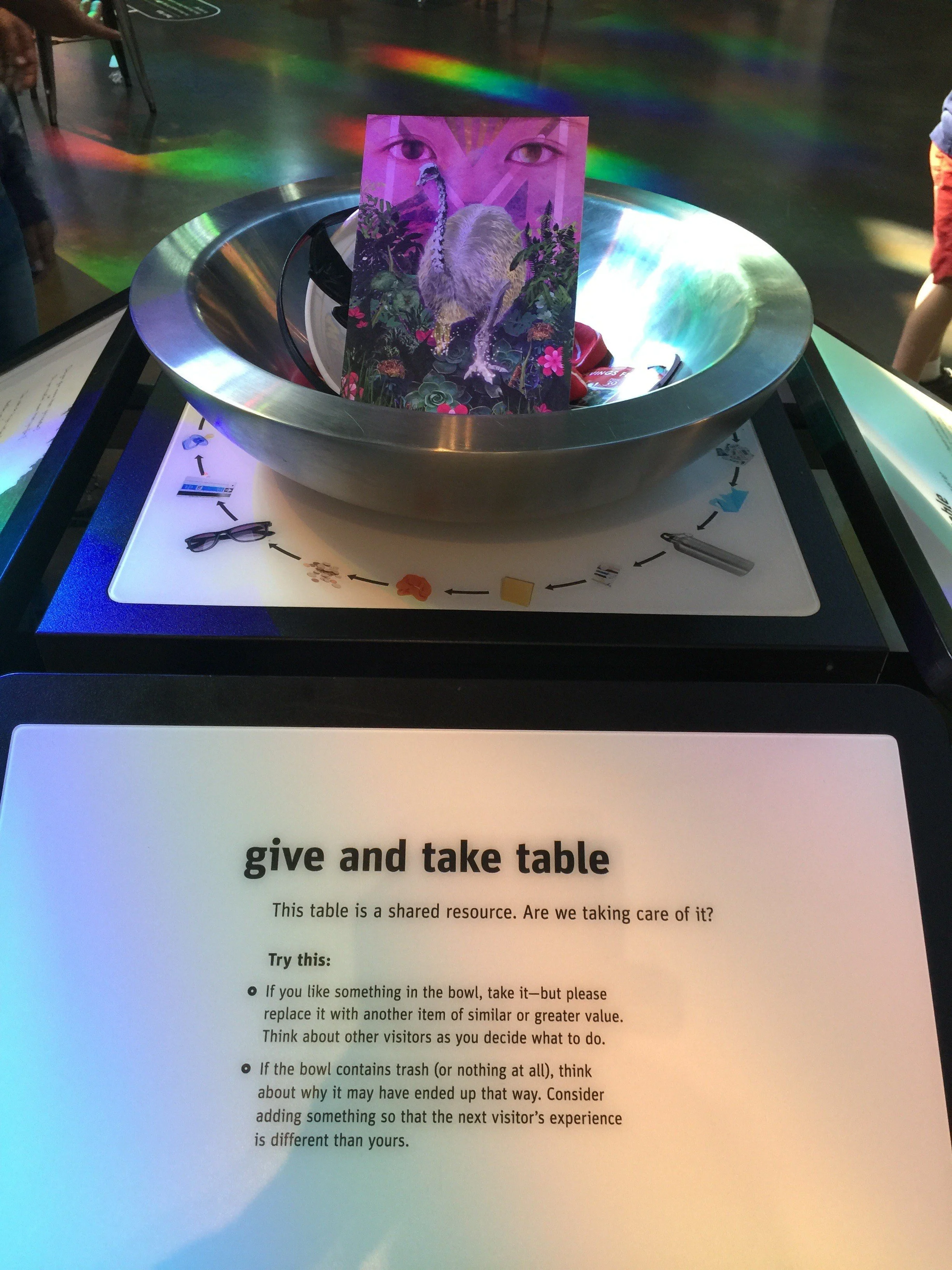
I was at the Exploratorium in San Francisco, the brainchild of Frank Oppenheimer who collected a “library of experiments”. It is full of wild energy with hundreds of screaming excited kids banging, pulling levers and pushing buttons. I was jet-lagged and tired and looking for a place to rest.
There I came across this plinth and bowl. I have always loved the underdog and with no bells and whistles - it stood quietly on its own:
I love this bit …”If the bowl contains trash (or nothing at all) think about why … Consider adding something so that the next visitor’s experience is different than yours”
I left the postcard pictured and wonder who took it. Did they think it was beautiful? Did it spark anything? Or did it get thrown away?
Mostly - Did they have a better experience because of me?
I also want to be moved …..
The Thoughtful Experience
At the Smithsonian National Museum of African American History and Culture in Washington, D.C., the journey is deliberate. You begin in the basement physically and emotionally in the dark history of slavery.
As you move upward, you pass through eras: but any relief you feel about emancipation is quickly tempered by the realities of segregation, racial terror, and systemic injustice.
What makes the experience so powerful is not just the content, but the intentionality of the design. The museum integrates contemplative spaces, chapel-like areas that offer a place to sit with the weight of it all.
When the museum first opened, it featured “reflection booths” where visitors could record their thoughts and responses. They were meant to be temporary. But people flocked to them. The need to speak, to process, to make meaning from what they had just witnessed (and share their own stories) was overwhelming.
At the very end, the final exhibits are Michael Jordan and Barack Obama. Symbols of excellence and power. So far removed from the heaviness felt below and wonderful because of everything that had to be walked through to get to them.
You will have your own versions of experiences that have moved you.
What Wonder Teaches Us About Strategy
Be it business, innovation, systems change or storytelling, a brilliant idea means nothing if it can’t be delivered, sustained, and loved into life.
Imagination is essential. It’s the spark. But imagining the future is only one part of the work. Bringing it to life and keeping it alive is where the real craft begins.
That’s where transactional friction comes in. It’s not just about execution, it is about reducing the drag. Even the most magical experiences (or the most disruptive ideas) won’t last long if their upkeep is unsustainable.
Everything has a rhythm — including business.
Like a powerful piece of music. Even in hardcore metal or thrash punk, it’s not just about playing loud. It’s about timing. If all the instruments and voices are playing full throttle at the same time, all of the time, the message gets lost (and it doesn’t sound so great)
Leave space for reflection and for the pauses.
To end here’s an exhibition at the National Library of New Zealand. I discovered a cupboard full of old computers and knew visitors would love to see these. Spot the original Apple logo at the front. We partnered with Yoobee School of Design students to produce posters for the display around zeros and ones (from Flight of the Conchords). This is an example of engaging your stack from our first newsletter. It was awesome but what you can’t see is the security person hovering about to make sure no harm came to the irreplaceable tech …. and that’s transactional friction.