Brazil
What changes when we experience leadership through another culture? Reflections on collective decision making, civic imagination, elder leadership and seeing systems differently.
The elders of São Paulo were debating their vision for the city. It came down to two schools of thought: embrace the natural beauty of the region and work in partnership with nature or embrace commerce and be a modern industrious city. The latter won. If you’ve been to São Paulo you will know that it is a hive of activity full of high-ways and skyscrapers, alongside majestic examples of brutalist architecture. It is not devoid of nature - there are parks and luscious greenery. But it is a city with no centre and concrete is king.
There are so many layers to this story, told to me by my wonderful host Ana who brought me to Brazil to talk about our work in culture-tech.
The story is about how we make decisions – big decisions. Decisions that impact inter-generationally. In hindsight, we have to believe that in all we do, we make the best decisions with the information we have at hand. With insight we ruminate on the impact of those decisions in the present day and with foresight we set about creating a better future. But we can never return back to the original proposition (the fork in the road). We build from here. Does it follow that the city would have been better had nature won? Possibly, probably – but hindsight is a generous teacher with terrible timing.
This story is also about human resilience and joy.
In response to the city design, major streets are closed on Sunday’s so the people can ‘community’. Only the day before I had travelled this highway in a car and a taxi. Now I was walking its centre watching an assortment of stunning Brazilians dancing, roller skating, biking with their kids, shopping at the market stalls, admiring their dogs and generally loving all over their gorgeous selves.
This story is also about climate of course. It is nice to imagine what the city could have been had they opted for the nature route. Brazil is home to 60% of the Amazon and nearly 12% of the world’s forests. Often called the lungs of the world, producing one-fifth of our planet’s freshwater and sheltering one-tenth of all known species.
It is also a story about faith.
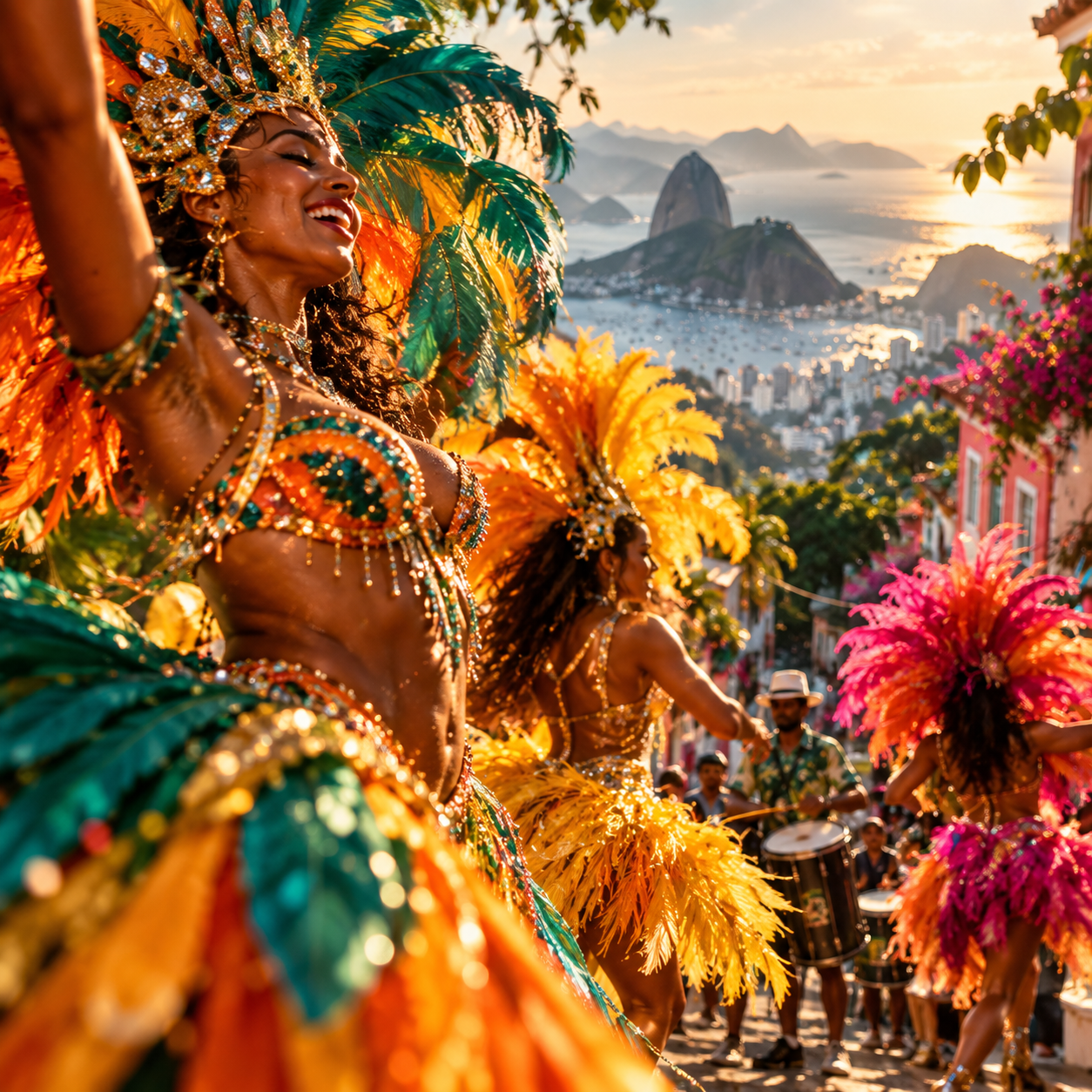
I must have been amazing, because I was invited back to Brazil for a second time to speak to Museum professionals. This time I took a detour to Rio. In the movie How Stella Got her Groove Back, Angela Basset and Whoopi Goldberg are in Jamaica staring out to the ocean and Whoopi says – God is Here. That’s how Rio felt. It is so beautiful, naturally. And God is there and I stood at the feet of Christ the Redeemer and wept. Then I gazed out over the city of Rio, in glorious weather, from the jungle to the city to Pão de Açúcar the sugar loaf mountains and out to the harbour. I was moved by the exquisite beauty of this planet.
Part of this story is also about art
I went to the Selarón Steps by Chilean Artist Jorge Selarón. Selarón began covering the dilapidated steps outside his home with brightly coloured tiles as a “tribute to the Brazilian people.” What started as a personal side project became his life’s work and he spent over 20 years transforming 215 steps with more than 2,000 tiles sourced from over 60 countries with millions of visitors each year.
I tried to pose on the step where Snoop Dog and Pharrell filmed the video to Beautiful. Being my particular cultural reference.
I had hoped there was some whimsical phrase in that song that I could weave into my Brazil ruminations and be like all hip hoppy cool. But there wasn’t a lot to choose from, other than Beautiful, I just want you to know, you’re my favourite girl which along with There’s something special about you, appears 26 times in the song. But that’ll do. Rio you are indeed beautiful and special.
This is also a story about history
Did you know that Brazil has the largest Japanese population outside Japan, with around 1.8 to 2 million people of Japanese descent? More than 70% of them live in São Paulo state. Japanese migration to Brazil began in 1908, when the ship Kasato Maru arrived in the port of Santos carrying 781 passengers, mostly farmers from southern Japan. They came to work on coffee plantations after the abolition of slavery in Brazil (1888), when the government was recruiting new labour for its agricultural economy.
Between 4 and 5 million Africans were forcibly brought to Brazil through the transatlantic slave trade about 40% of all enslaved Africans taken to the Americas.
Slavery in Brazil had lasted for more than three centuries (1500s–1888) and Brazil was the last country in the Western world to abolish slavery, formally ending it with the Lei Áurea (Golden Law) on May 13, 1888. According to my research (my trusty friend Kōrero), Lei Áurea only had two articles: Slavery is declared extinct in Brazil and all contrary legislation is revoked. Resulting in the freedom of an estimated 700,000 still enslaved people.
At the museum conference we heard from a director whose museum was housed at the city’s gallows square, the place where enslaved Africans were executed.
Geo-Politically, I was visiting Brazil before their general election and markets were in flux. Brazil is the only country I have ever visited where the New Zealand dollar was stronger than the local currency. I’d been in the US not long before then and was used to adding on 30 to 40 percent more for everything. Here it was a 25% discount. I thought about this as I watched minted US and European tourists on my tours. Imagine that kiwi’s – travelling the world on euro’s?
This is lastly a story of culture.
My friends Ana and Rick took me to a traditional folk song evening where the community came together to sing. The chairs in the large traditional hall were arranged in a square with a modest table in the middle. On the table was a thin candle. Around the table were the band – around 7 people mainly playing guitars. Then we were arranged around them. The candle was lit and the singing would last for us long as the candle flame.
Rick also took me to an art shop to buy some things to take home He laughed when I selected Tia Ciata. She was a Candomblé priestess, cook, healer, community leader, and host of legendary musical gatherings at her home in the early 20th century. Her house in Rio became the cradle of samba, nurturing musicians who would later define Brazil’s national sound.
Tia Ciata (above) is celebrated as a symbol of Afro-Brazilian femininity, sass, and creative power. There is also Pomba Gira who is a spiritual archetype and patron of confident, sensual, independent women. And then there is Iemanjá — mother of the sea, keeper of tides and tenderness. On her feast day, thousands gather dressed in white, carrying flowers and perfume to the water’s edge. They whisper wishes and let them drift on the waves, trusting the ocean to deliver what the heart cannot hold. She is strength and softness intertwined, protector of women, patron of the lost, and proof that beauty can rise even from the depths.
I love a nation that celebrates female potency.
…and this feels like the perfect place to end this story.
So as the candle burns low and the song lingers, we’re reminded that our decisions matter and even from the hardest ground, something beautiful (and really really special) can take flight.
Final thoughts
Someone recently remarked that they were never sure just exactly what was going to come out of my mouth (or in my writing). They meant it in a positive way – we’re friends and sit on boards together. Thing is I never know either. I keep wondering if I have anything else to say and perhaps my foray into creative writing is over. But then I remember something that has moved me, made me curious or tickled my fancy and voila! a stream of consciousness is born.
Interestingly, it’s not always the hero or main event that is the source of my tickling. More often it’s the side event or the understudy or the thing that only appeals to me. Because every moment of wonder and awe is shaped by our individuality.
It’s the conversation in the car about the founding of the city, on the highway that will close on Sunday so you should go visit. It’s the conversation with beautiful hosts that was passing time and making small talk as we travelled to the next meeting.
That’s the thing - inspiration is often found around the edges.